You use your fingers every single day, yet many people never stop to think about why finger names exist or what each one truly represents. Understanding finger names helps you communicate clearly, learn anatomy basics, and appreciate how hands function in daily American life.
This guide explains finger names in simple, accurate language while connecting history, structure, and real-world use. You will learn what each finger is called, why it has that name, and how it plays a role in work, communication, and culture.
What Are Finger Names and Why They Matter
Finger names are the standard terms used to identify each of the five digits on your hand. These names allow you to communicate clearly in education, healthcare, fitness, and everyday instructions. Without finger names, simple directions like gripping tools or learning skills would become confusing and inefficient.
Finger names matter because they connect anatomy with function. Each finger has a distinct role that supports movement, strength, and precision. Understanding these names helps you follow instructions accurately in classrooms, workplaces, and medical settings.
Finger names are also deeply rooted in language and culture. In American English, the naming system blends anatomy, history, and function into simple terms. This balance makes finger names easy to remember and universally understood.
The Five Finger Names on the Human Hand
The human hand has five fingers that work together to create strength and control. Each finger name reflects its position, size, or role. Knowing these names helps you describe hand movements clearly and correctly.
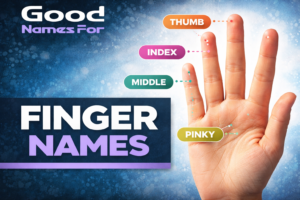
The five finger names are the thumb, index finger, middle finger, ring finger, and little finger. These names are used consistently across schools, healthcare systems, and everyday communication in the United States. Each one contributes to grip, balance, and dexterity.
When you understand finger names, tasks like learning music, typing, or handling tools become easier. This shared language ensures clarity in both professional and casual environments.
The Thumb
The thumb is the shortest and thickest finger on your hand. It sits apart from the other fingers and allows you to grasp, pinch, and hold objects firmly. Without the thumb, everyday tasks like opening jars or using a phone would be extremely difficult.
The name thumb comes from an old word meaning thick or swollen. This description matches its strong structure and unique movement. Its ability to oppose the other fingers makes it essential for hand function.
In American culture, the thumb often symbolizes approval or agreement. This shows how finger names also connect to gestures and communication beyond anatomy.
The Index Finger Explained
The index finger is the finger you naturally use for pointing. Its name comes from a Latin word meaning to indicate or show. This finger plays a major role in communication and direction.
You rely on the index finger for tasks that require precision and control. From pressing buttons to typing and writing, it acts as a guide for fine motor skills. Its length and placement make it ideal for detailed movements.
When learning skills that involve hand positioning, such as crafts or games, the index finger often leads. Clear understanding of this finger name improves coordination and accuracy.
The Middle Finger and Its Purpose
The middle finger is the longest finger on your hand. Its name is straightforward because it sits between the index finger and ring finger. This central position gives it balance and strength.
You use the middle finger to support grip and distribute force evenly. It works closely with the index and ring fingers during lifting or holding. Its length helps stabilize hand movements.
In American culture, the middle finger is also associated with gestures. While anatomy defines its function, social meaning has added layers to how this finger is perceived.
The Ring Finger and Its Cultural Meaning
The ring finger is traditionally the finger where rings are worn. Its name comes from this long-standing custom. In the United States, wedding and engagement rings are most commonly placed on this finger.
This tradition is linked to the belief that a vein connects the ring finger directly to the heart. While modern science does not support this idea, the symbolism remains strong. The name ring finger reflects this cultural history.
The ring finger also supports grip and coordination. Although it is less independent than the index or middle finger, it plays a key role in hand stability.
The Little Finger or Pinky
The little finger is the smallest finger on your hand. It is also commonly called the pinky in American English. The word pinky comes from a term meaning small or little.
Despite its size, the little finger adds significant strength to your grip. Studies show that removing pinky support can reduce grip strength by up to 50 percent. This highlights its importance in everyday tasks.
You use the little finger for balance and fine control. From typing to holding tools, it quietly supports hand function in powerful ways.
Finger Names in Anatomy and Medical Use
In anatomy, finger names help doctors and therapists communicate clearly. Each finger contains bones called phalanges that support movement. Understanding finger names helps you follow medical advice accurately.
Medical professionals use finger names when diagnosing injuries or planning treatment. Clear terminology reduces confusion and improves patient care. This is especially important in physical therapy and rehabilitation.
If you are learning about hand health, knowing finger names makes information easier to understand. It allows you to describe pain, movement issues, or injuries with precision.
Finger Names and Everyday Activities
You use finger names constantly without realizing it. Instructions like lift with your index finger or support with your thumb rely on shared understanding. This common language keeps tasks efficient and safe.
Finger names are especially important in education and skill-building. Music lessons, typing classes, and sports training all depend on accurate finger identification. Clear naming improves learning speed and confidence.
When you explore creative naming ideas for hobbies or projects, understanding naming systems helps spark inspiration, much like browsing ideas on pages such as good names for pets.
Finger Names Across Cultures and Languages
Finger names vary slightly across cultures, but the functions remain similar. Some languages name fingers based on use rather than position. This shows how culture shapes language.
In American English, finger names balance simplicity and clarity. This makes them easy to learn and apply in daily life. The system works well across professions and age groups.
Understanding cultural differences in finger naming builds awareness. It also helps when learning new languages or working in diverse environments.
Learning Finger Names for Kids and Students
Finger names are often taught early in childhood education. Songs, diagrams, and games help children remember each finger. This foundation supports future learning in writing and coordination.
Teachers rely on finger names to guide students during activities. Clear instructions help children develop fine motor skills safely and effectively. Early learning builds confidence and independence.
Educational tools that focus on naming systems, similar to themed girls name collections, show how structured naming helps memory and understanding.
Finger Names in Gestures and Communication
Finger names are closely tied to gestures used in communication. Thumbs up, pointing, or counting all depend on shared finger recognition. These gestures are common in American culture.
Understanding finger names helps you interpret body language correctly. It also ensures respectful and appropriate communication in social settings. Gestures carry meaning beyond words.
When gestures are explained clearly, misunderstandings decrease. This shows how anatomy and language work together in daily interaction.
Common Questions About Finger Names
Many people ask whether the thumb counts as a finger. In anatomy, it is considered a digit and is commonly included among the five fingers. This classification helps maintain consistency.
Another common question involves why fingers have different levels of independence. This depends on muscle and tendon connections within the hand. Finger names help explain these differences clearly.
Curiosity about naming systems often leads people to explore other naming topics, similar to browsing creative lists like boys’ names.
Conclusion
Understanding finger names gives you a clearer view of how your hands work and why each digit matters. These names connect anatomy, culture, and function into a system that supports everyday life in the United States. When you know finger names, you communicate better, learn faster, and appreciate the complexity of simple movements. From medical use to daily tasks, finger names create clarity and confidence. By mastering this knowledge, you gain practical insight into one of the most important tools you use every day.